This post may contain relevant affiliate links. These give me a small commission at no additional cost to you if you make purchases with them. Please see my disclaimers for more information.
If you’re here, I’m guessing you’ve hit that wall wondering how to get traffic to your website without social media: the one where you’re business goes to die in a saturated algorithm. You want your website to actually work—not just feel good for five minutes before you’re back to doom-scrolling your own analytics.
Good news! You’re not stuck… Social media is one visibility lever, not the only one. And honestly? Some of the quietest, most sustainable ways to grow your traffic don’t require you to post a single Reel.
I built The Copy Sloth® on the idea that visibility comes from voice—not volume. You don’t need to be loud, trendy, or “on” 24/7 to be found. You need the right words in the right places, working for you while you’re doing literally anything else.
So instead of handing you a random grab-bag of tactics, I want you to think of your traffic sources in three buckets: what you already own, what compounds quietly over time, and what you borrow from someone else’s audience. Let’s walk through all three.

This post is all about how to get traffic to your website without social media.
Why It’s Worth Ditching Your Social Media Dependency (Even a Little)
Before we get into the how, let’s talk about the why—because the numbers back this up more than you’d think.
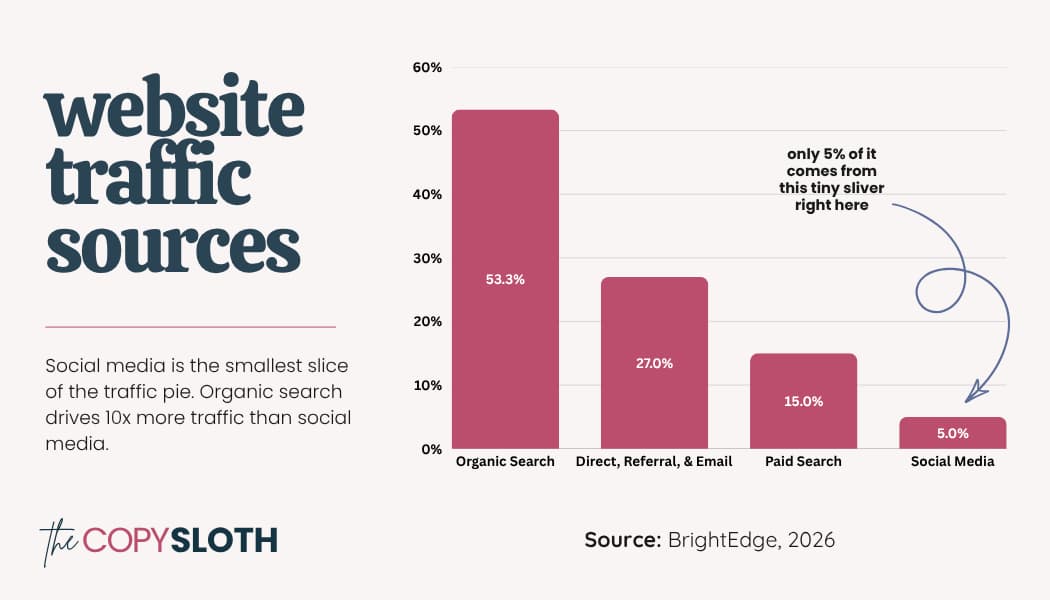
According to BrightEdge’s 2024 traffic-channel research, organic search drives 53.3% of the average website’s trackable traffic, compared to just 5% from social media and roughly 15% from paid search. That’s more than ten times the pull social gives you.
And it’s not a fluke! Companies that blog consistently generate an average of 67% more monthly leads than those that don’t. Businesses that prioritize blogging are 13 times more likely to see a positive return on their marketing investment(s), according to Demand Metric data.
Here’s the other piece nobody tells you: content built for search sticks around.
A 2026 study by Scott Graffius found that the average half-life of a blog post is about 2 years, compared to roughly 3.75 months for a Pinterest pin—and mere hours for platforms like X or Instagram. Translation: a blog post you write once in an afternoon can keep bringing you traffic long after you’ve forgotten you wrote it. A social post can’t compete with that kind of shelf life.
Okay, numbers digested. Let’s build your traffic plan, bucket by bucket.
Bucket 1: Claim the Traffic You Already Own
These are the assets nobody can take from you—no algorithm update, no platform ban, no shift in the trending audio. This is where I’d start if I were you.
1. Build an Email List You Actually Own
This one’s close to my heart (and my whole business, honestly). Your email list is the one audience an algorithm can’t take away from you. And when you’re caught in the “how to get traffic to your website without social media” conundrum, that matters!
When you post on social media, you’re renting attention. When someone joins your email list, you have a direct line to them—no algorithm deciding whether they see you today. According to Statista, an average of 70% of people across generations prefer hearing from brands via email, and Litmus puts average email ROI at $36 back for every $1 spent.
Action items:
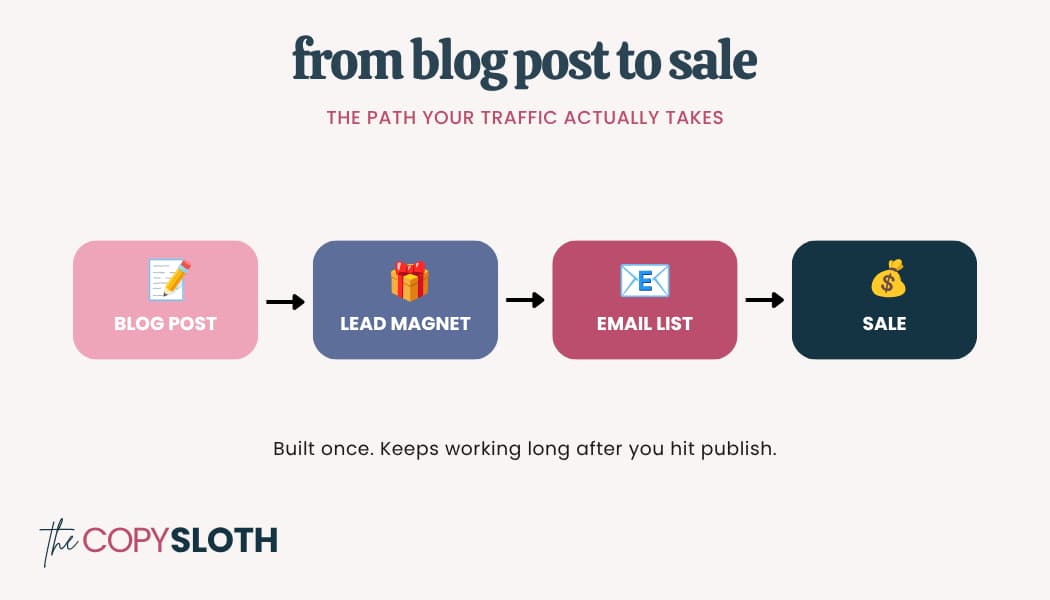
- Create one lead magnet (a checklist, template, or short guide) that solves a small, specific problem for your ideal client.
- Link to it at the end of every blog post you write.
- Send a regular email—weekly or biweekly—that keeps you top of mind without demanding daily output like social media does.
2. Optimize the Website Pages You Already Have (SEO & AEO)
Before you create anything new, squeeze more out of what’s already live. Your homepage, service pages, and About page are working (or not working) for you right now, whether or not you’re posting on social media.
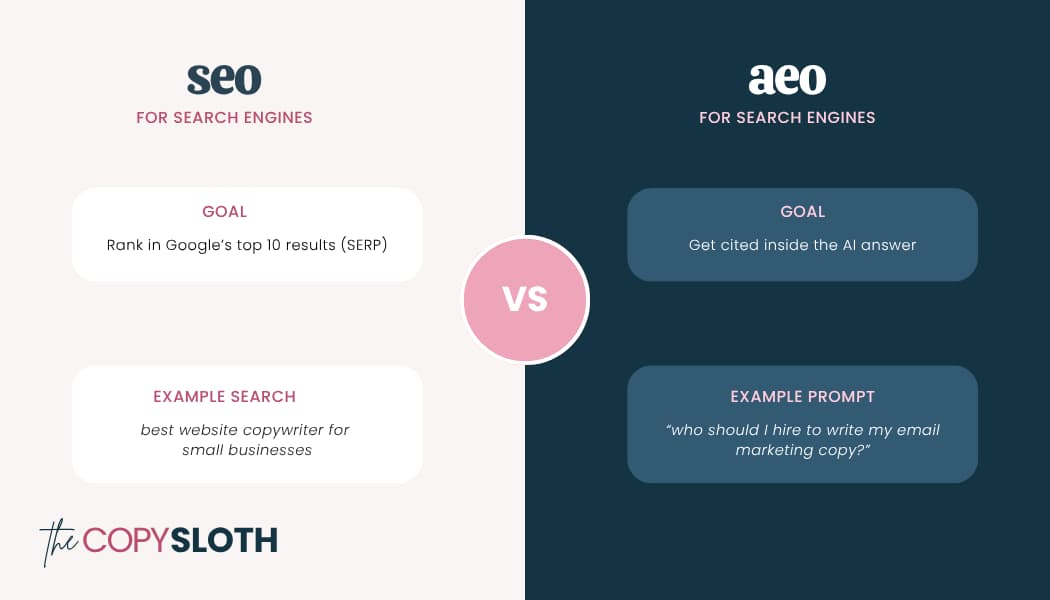
This means optimizing for SEO (search engine optimization, which is writing and structuring your site so Google can find and rank it) and its newer cousin, AEO (Answer Engine Optimization). AEO is about structuring your content so AI tools and chatbots pull your words into their answers when someone asks a question your business can solve.
Both matter because people searching or asking AI directly for a service provider are primed to buy. They’re not casually scrolling—they’re looking for a solution, and if your website is the clearest answer, you win the click (or the AI recommendation).
Action items:
- Make sure your homepage, service pages, and About page each target a clear, specific phrase your ideal client would search (not just your business name).
- Answer questions directly and early in your content—AI tools favor clear, quotable answers over long windups.
- Use descriptive headers (like the ones in this post) so both humans and search engines can scan your structure.
Learn More: Here’s everything you should know about what website copywriting actually is.
Bucket 2: Build Assets That Compound Quietly Over Time
This is where the patient, introvert-friendly magic happens. You do the work once, and it keeps working long after you’ve moved on to the next thing.
3. Start Blogging (It Feeds Everything Else in This Post)
I’m not going to bury this one. If you want real, lasting traffic without social media, blogging is your foundation. Nearly everything else on this list either feeds your blog or gets fed by it.
Here’s why it works so well:
- It gives Google (and increasingly, AI tools like ChatGPT and Google’s AI Overviews) something to actually find and recommend you for.
- It gives you something worth pinning on Pinterest.
- It gives you a place to send people from guest posts, podcasts, and your email list.
- It gives your website a reason to keep growing instead of sitting there static.
Action items:
- Pick one question your ideal client Googles before they hire someone like you. Write a genuinely helpful, specific answer to it—not a vague “10 tips” post, an actual answer. That’s your first post.
4. Use Pinterest Like the Search Engine It Actually Is
I know—Pinterest gets lumped in with “social media” a lot. But it behaves more like a visual search engine, and the numbers make a strong case for treating it that way.
- Pinterest now has 631 million monthly active users. The platform processes more than 2 billion searches a month.
- Unlike Instagram or TikTok, people come to Pinterest already looking to plan, buy, or solve something—about 80% of users say that the platform’s shopping experience inspires them to buy.
Here’s the catch (and it loops right back to blogging): Unless you’re an e-commerce store with a bunch of products or fleet of courses at the ready, Pinterest historically works well for your business if you’re also blogging. Pinning links to your homepage doesn’t give people much to engage with. Pinning your blog posts does.
Action items:
- Create 2-3 pin graphics per blog post, each with a different headline or angle, and link them all back to that post. Then stagger each post with at least 2 days between when scheduling them to go live.
Bucket 3: Borrow an Audience You Haven’t Earned Yet
Sometimes the fastest way to get in front of new people isn’t to build something from scratch—it’s to show up, briefly and well, in a room someone else already filled.
5. Guest Post for Backlinks (and Borrowed Trust)
Guest posting still works—when it’s done well. Most marketers agree that guest posting is the most effective link-building strategy out there—65% say so, to be exact. And if you go long-form (1,500+ words or more), you’ll pull in 67% more referral traffic per placement than shorter posts get.
Beyond the SEO boost, guest posting puts you in front of an audience that already trusts the host—so some of that trust transfers to you.
Action items:
- Make a short list of blogs, newsletters, or sites your ideal client already reads.
- Pitch one specific, useful post idea (not “can I write for you sometime”)—editors say yes to specifics.
- Ask for the link to live naturally in the body of the post, not just your bio.
6. Guest on Podcasts (Especially If You’d Rather Talk Than Write)
If writing isn’t your thing but talking is, podcast guesting is your move. It’s one of the most efficient ways to earn high-quality backlinks and reach a warm, engaged audience without creating content from scratch.
And the audience is real: 58% of Americans age 12+ now listen to podcasts monthly—an all-time high of about 167 million people, according to Edison Research’s 2026 Infinite Dial report.
Show notes are the real prize for you here—links placed in a host’s show notes tend to carry more weight with Google than a generic directory link because they’re editorial and contextual, placed by a real person vouching for you.
Action items:
- Search “[your industry] podcast guest application” to find shows actively looking for guests.
- Pitch a specific story or result, not just your general expertise.
- Always ask if the show publishes show notes with a link back to your site.
7. Show Up in Small, Specific Communities (Online or In Person)
You don’t need to network with everyone. You need to find the few rooms—digital or physical—where your actual people already hang out.
This could be a small paid mastermind, a niche Facebook or Slack group, a local small-business meetup, or a “need a guest” community where hosts and guests find each other. The smaller and more specific the group, the better it tends to convert, because you’re not competing with noise—you’re one of a handful of familiar faces.
Action items:
- Join or attend one small, specific community this month (not five). Show up consistently before you try to promote anything.
Bonus Lever: Paid Search (Once You’re Ready)
I’d be leaving something out if I didn’t mention paid search ads. They’re not required, and I wouldn’t start here—but once your website is set up to convert, a small, well-targeted Google Ads budget can supplement everything you’ve built in the three buckets above.
One Honest Caveat: Paid traffic only pays off if your site converts once people land on it. I’d recommend working with someone who knows what they’re doing here (or at least tracking your numbers closely) so you’re not just paying to watch people bounce.
Traffic Is Only Half the Job—Your Website Still Has to Convert
Here’s the truth nobody wants to hear: getting traffic to your website without social media is only step one. If your site doesn’t clearly say who you help, how you help them, and what to do next, all that lovely organic traffic just… leaves.
This is the part where the quiet, human-first copy comes in. Not hype. Not pressure. Just clear, warm words that make it obvious you’re the right fit—so the people finding you through search, Pinterest, guest posts, or your email list actually stick around long enough to become clients.
If you’ve been driving traffic and still not seeing it convert, that’s usually a copy problem, not a traffic problem. Let’s fix your words so they finally match your effort.
Quick recap: Here’s How to get traffic to your website without social media
Own it:
- Build an email list
- Optimize the website pages you already have
Compound it:
- Start blogging
- Use Pinterest as a search engine
Borrow it:
- Guest post for backlinks
- Guest on podcasts
- Show up in small, specific communities
Add it (when ready):
- Paid search
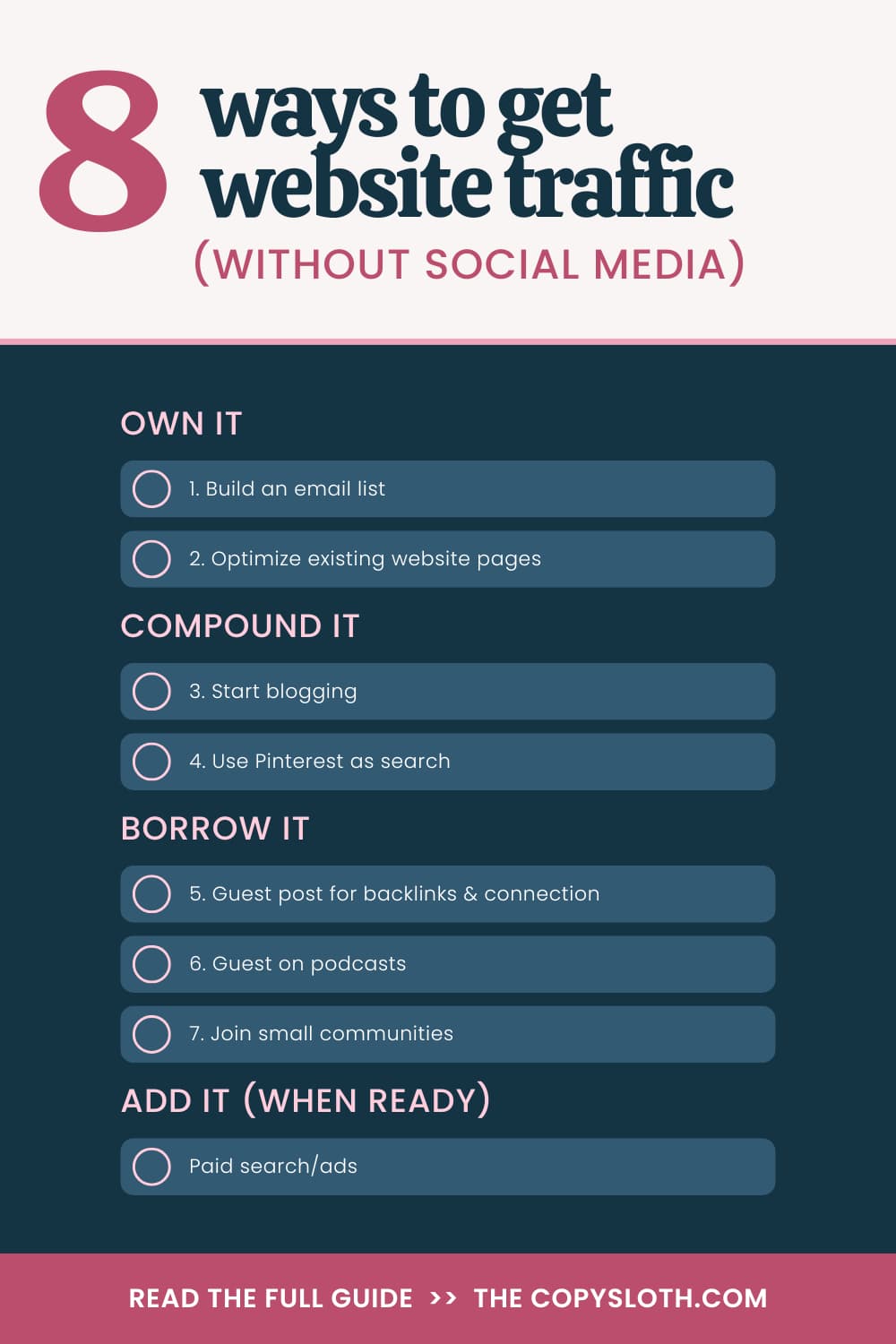
This post was all about how to get traffic to your website without social media.