This post may contain relevant affiliate links. These give me a small commission at no additional cost to you if you make purchases with them. Please see my disclaimers for more information.
If you’ve ever stared at your own homepage wondering why the words on it aren’t doing more for your business, you’re in the right place. “What is website copywriting” is one of my favorite questions I get asked as a (you guessed it) website copywriter.
That’s the whole idea behind The Copy Sloth®: visibility comes from voice, not volume. Your website doesn’t need to shout. It needs to say the right thing, to the right person, at the right moment.
In this guide, I’m walking you through exactly what website copywriting is, what a website copywriter actually does, and how to tell whether you need to hire one or you’re ready to write it yourself.

So What Is Website Copywriting, Really?
Website copywriting is strategic, persuasion-focused writing that moves a reader toward a specific action—booking a call, buying a product, joining your list—rather than just informing or entertaining them.
That’s the technical definition, anyway. Here’s a more human one: it’s the difference between a website that talks about you and a website that talks to your ideal client. I also always preach that strong copy repels the right people (i.e., folks who aren’t within your target audience).
Now that we’re square on the boring definitions, let’s get into what you can expect in this guide:
What copy is and is not (Content)
People mix up “copy” and “content” constantly, so let’s clear that up first, because it changes how you approach every single page on your site.
- Content builds relationships and drives traffic. Think blog posts, YouTube videos, and social captions—things people consume because they’re helpful or entertaining.
- Copy is built to convert. It’s the words on your homepage, service pages, and sales pages that guide someone from “huh, interesting” to “where do I sign up?”
Your website needs both, sure. But if the copy (the actual sales-driving words) is an afterthought, you’re basically running a beautiful storefront with no one behind the counter.
Did You Know? More than half of all pageviews (55% to be exact) get less than 15 seconds of real attention, based on an analysis of 2 billion visits (Tony Haile, TIME, drawing on Chartbeat data).
In the end, your words MUST pull their weight in those first few scanning seconds—or they’re quietly costing you visitors, and sales, before anyone even gets to your offer.
Why Website Copywriting Matters More Than You’d Think
Visitors form a first impression of your website in about 50 milliseconds. Yes, milliseconds. That snap judgment strongly predicts how they’ll rate your site’s credibility even after spending more time on it (Lindgaard et al., Behaviour & Information Technology). Google’s own research later confirmed people start forming opinions in as little as 17 milliseconds. You genuinely do not get a second chance at that first breath of a moment.
And once someone sticks around past that first blink? Your words are still doing the heavy lifting:
- Switching CTA copy from second-person to first-person — “Start Your Free Trial” to “Start My Free Trial” — increased clicks by 90% in a widely cited split test run by conversion specialist Michael Aagaard (SiteTuners’ recap of the ContentVerve/Unbounce test). Personalized calls-to-action convert 202% better than generic ones, per HubSpot’s own analysis of more than 330,000 CTAs (HubSpot). In a Portent study of 33 client sites, a website’s readability score accounted for up to 13% of conversion rate variance on e-commerce sites — not the deciding factor, but a real, measurable one (Portent).
This is why I tell my clients: if you’re driving traffic to your website and it’s not converting, that’s usually a copy problem, not a traffic problem. You can have the prettiest design and the smartest SEO strategy in the world, but if the words don’t make the case for why you, none of it converts.
But what Does a Website Copywriter Do?
In short: a good website copywriter is part strategist, part researcher, part architect, and part wordsmith. The actual writing is often the smallest piece of the timeline, even though it’s the part people notice first.
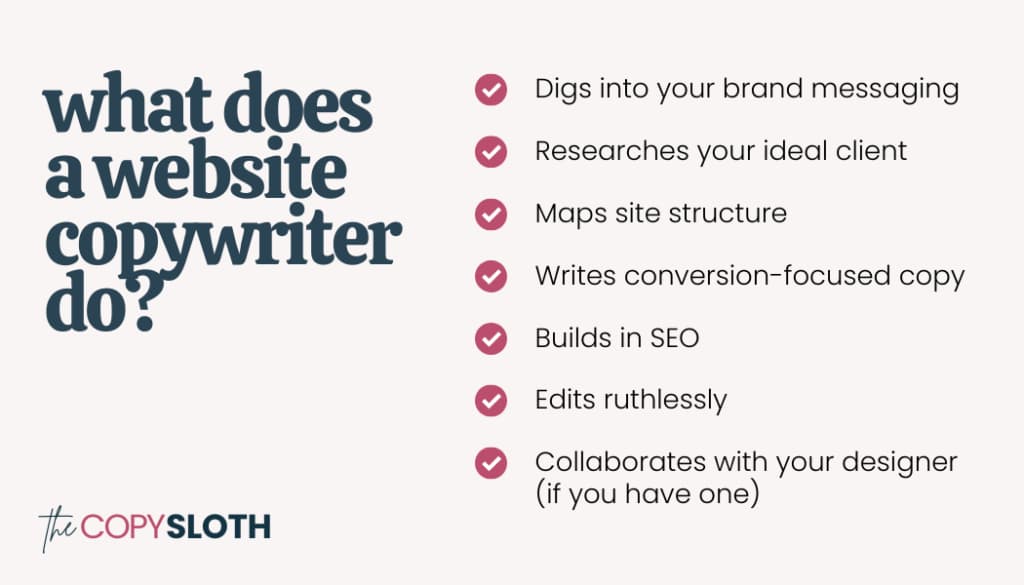
1. Digs into your brand messaging first
A good website copywriter gets specific about who you serve, what problem you solve, and why you’re uniquely positioned to solve it before they write a single word for your homepage. This is the unglamorous ‘homework’ phase, and it’s honestly where most of the magic happens—it’s the foundation that carries every page.
2. Researches your ideal client (not just your business)
A website copywriter doesn’t just interview you. They dig into how your ideal client talks, what keeps them up at night, and what objections are quietly stopping them from hitting “buy.” This has a name: voice-of-customer (VoC) research. It’s how your copy ends up sounding like it truly understands your visitor.
Tip: VoC research offers several ways to get client info: interviews, surveys, social media, calls, reviews, focus groups, feedback forms, client behavior mapping, and more per HelpScout.
3. Maps out the structure of your site (not just the sentences)
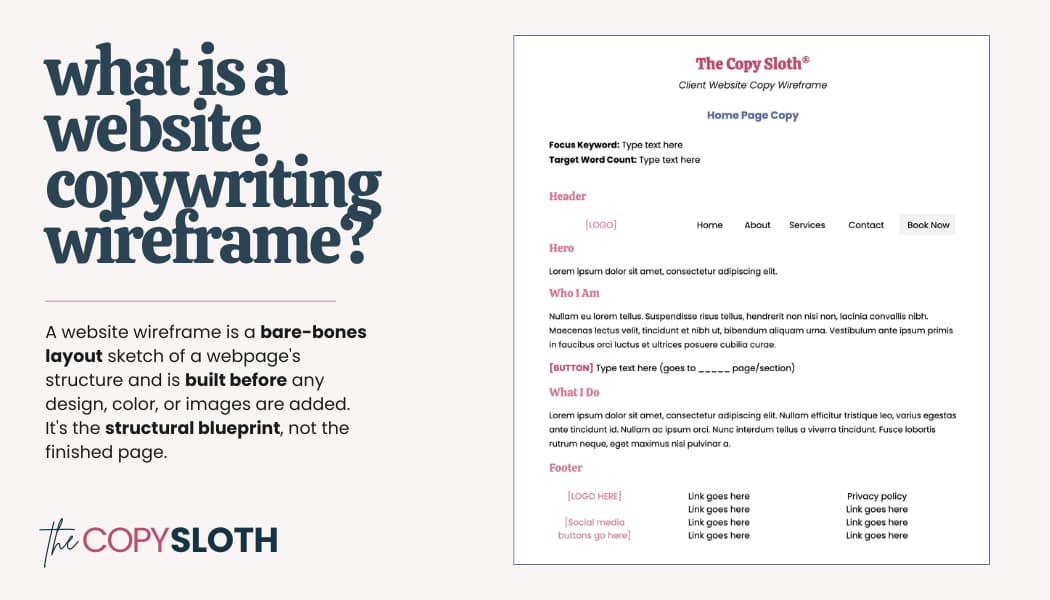
A website copywriter often acts like an architect for your website: deciding what pages you need, what order information should appear in, and how each page hands the reader off to the next. Many copywriters (myself included) build out a wireframe: a simple layout showing exactly where each headline, section, and call-to-action lives before a designer ever touches it.
4. Writes copy built to convert—not just to sound nice
This is the part everyone pictures: writing your homepage, About page, service pages, and calls-to-action. But it’s not about clever wordplay for its own sake. Every sentence has a job: build trust, answer an objection, or move the reader one step closer to saying yes.
5. Weaves in SEO, without sacrificing the human part
A website copywriter helps your ideal client actually find your site—researching the phrases they search, writing clear title tags and meta descriptions, and structuring headers so both people and search engines can scan your page easily. The best SEO tip I can give you? Write a genuinely good, clear page. Search engines favor human-sounding, helpful content.
Tip: SEO (search engine optimization) is the practice of writing and structuring your website so search engines can find it, understand it, and rank it for the terms your ideal client is searching.
6. Edits ruthlessly
Good website copywriters cut the fluff—the extra paragraph about your life story that doesn’t move the reader closer to a decision, the jargon that makes you sound smart but leaves your reader confused. If it doesn’t serve the sale or the connection, it goes.
7. Collaborates with your designer
Copy and design work together from the start—not as an afterthought tacked on at the end. A website copywriter typically hands off wireframed copy to your designer (or you, if you’re DIYing your design) so the words and the visual layout are working together, not fighting each other for attention.
Website Copywriting vs. DIY: Which Is Right for You?
Not everyone needs to hire this out immediately, and I’ll never tell you that you have to. Here’s a simple, honest way to think about it.
|
Your Situation |
Recomm. Action |
Why |
Signs You’re Ready |
Common Mistake |
Quick Win |
|---|---|---|---|---|---|
|
You’re early-stage and still figuring out your offer or audience. |
DIY |
You need room to test messaging before locking anything in. |
You can describe your offer in one sentence and roughly know who it’s for. |
Trying to write “final” copy before your offer has settled. |
Draft one sentence: “I help [who] do [what].” |
|
You genuinely enjoy writing and have time to learn the strategy. |
DIY |
The core skills are learnable with the right time investment. |
You’ve got a few uninterrupted hours a week and patience to revise. |
Focusing on clever wording instead of clear structure. |
Read your homepage draft out loud and cut anything you wouldn’t say to a friend. |
|
Spend your budget elsewhere right now. |
DIY |
A solid template gets you most of the way there. |
You’re comfortable following a framework instead of building from scratch. |
Using a template without customizing the voice to sound like you. |
Grab a website copy template and fill in just your homepage first. |
|
You’ve rewritten your homepage five times and it still doesn’t sound right. |
Hire |
An outside strategic eye can spot what you can’t see anymore. |
You’re too close to your own words to edit them objectively. |
Rewriting sentences instead of fixing the underlying strategy. |
Book a copy audit before a full rewrite to pinpoint the real problem. |
|
You know your offer is solid, but your site isn’t converting traffic. |
Hire |
This usually signals a copy problem, not a traffic problem. |
You’re getting visitors but few inquiries or sales. |
Pouring more money into traffic instead of fixing the page it lands on. |
Swap vague CTAs (“Learn More”) for specific ones (“Book Your Free Consult”). |
|
You’d rather spend your limited time serving clients. |
Hire |
Once you’re busy, your time is your most valuable resource. |
Writing your own copy keeps getting bumped to “someday.” |
Waiting until you’re completely overwhelmed to finally outsource. |
Block time this week to gather examples of copy you love, ready to hand off. |
|
Your business has grown or shifted, and your copy describes an old version of you. |
Hire |
Outdated copy actively repels your current right-fit leads. |
Clients say “I didn’t realize you also did X” — your offer changed, your site didn’t. |
Assuming a small tweak will fix copy built for a different business model. |
Audit your homepage headline — does it still match what you sell today? |
A few DIY-ing Tips
If you do decide to DIY your website copy, here are a few quick, actionable habits that make an immediate difference:
- Write short, skimmable paragraphs. Most visitors are on their phones. Visitors skip big blocks of text entirely.
- Say it simply. If your industry jargon needs a translator, it needs a rewrite instead.
- Write like you talk. Read your copy out loud. If you’d never say it to a friend over coffee, cut it.
- Lead with the reader, not you. Swap “we offer” and “I provide” for “you get” as often as you can.
- Edit twice as much as you write. Reread your draft and delete every sentence that doesn’t move the reader closer to saying yes.
How Much Does Website Copywriting Cost?
Nearly all of the articles that pop up on this search results page all quote the same abstract “it varies” ranges. Almost none of them actually list real prices, so here’s what I charge as of August 2026. These rates are subject to change and are NOT a valid quote
- Full website projects (up to 7 webpages): $1750 (or $250 per page)
- Micro website projects (up to 3 webpages): $975 (or $325 per page)
Most of the copywriters online charge a baseline of $3000 for a full website. I choose to keep my prices relatively more affordable simply because I’m disabled. Accessibility matters so much to me. I just don’t subscribe to the whole “you get what you pay for” mentality because it belittles copywriters who opt to charge less than what’s considered normal.
A few FAQs About Website Copywriting
Quick Recap: What Is Website Copywriting?
Here’s the whole thing in one tidy scroll:
- Website copywriting is strategic, persuasive writing built to turn website visitors into subscribers, leads, or clients—different from content, which builds relationships and traffic.
- It matters because first impressions form in milliseconds, and unclear or low-quality copy quietly drives visitors away before they ever get to know you.
- A website copywriter’s job covers brand messaging, audience research, site structure, persuasive writing, SEO, editing, and designer collaboration—not just “writing nice sentences.”
- You can DIY your copy early on with a few solid habits, or hire it out once your offer is solid but your website still isn’t converting.
- Investing in website copywriting is simply asking your website to finally do the job it was built for.

This post was all about answering the question, “What is website copywriting?”
Still here?
If you’ve read this far and you’re realizing your website has been quietly working against you this whole time, that’s not a you problem. That’s a “nobody ever taught you this” problem. And it’s a very fixable one.
You don’t need to be loud, salesy, or “on” 24/7 to have a website that sells. You need the right words, in the right order, doing the quiet work for you. That’s exactly what I help my clients build.